
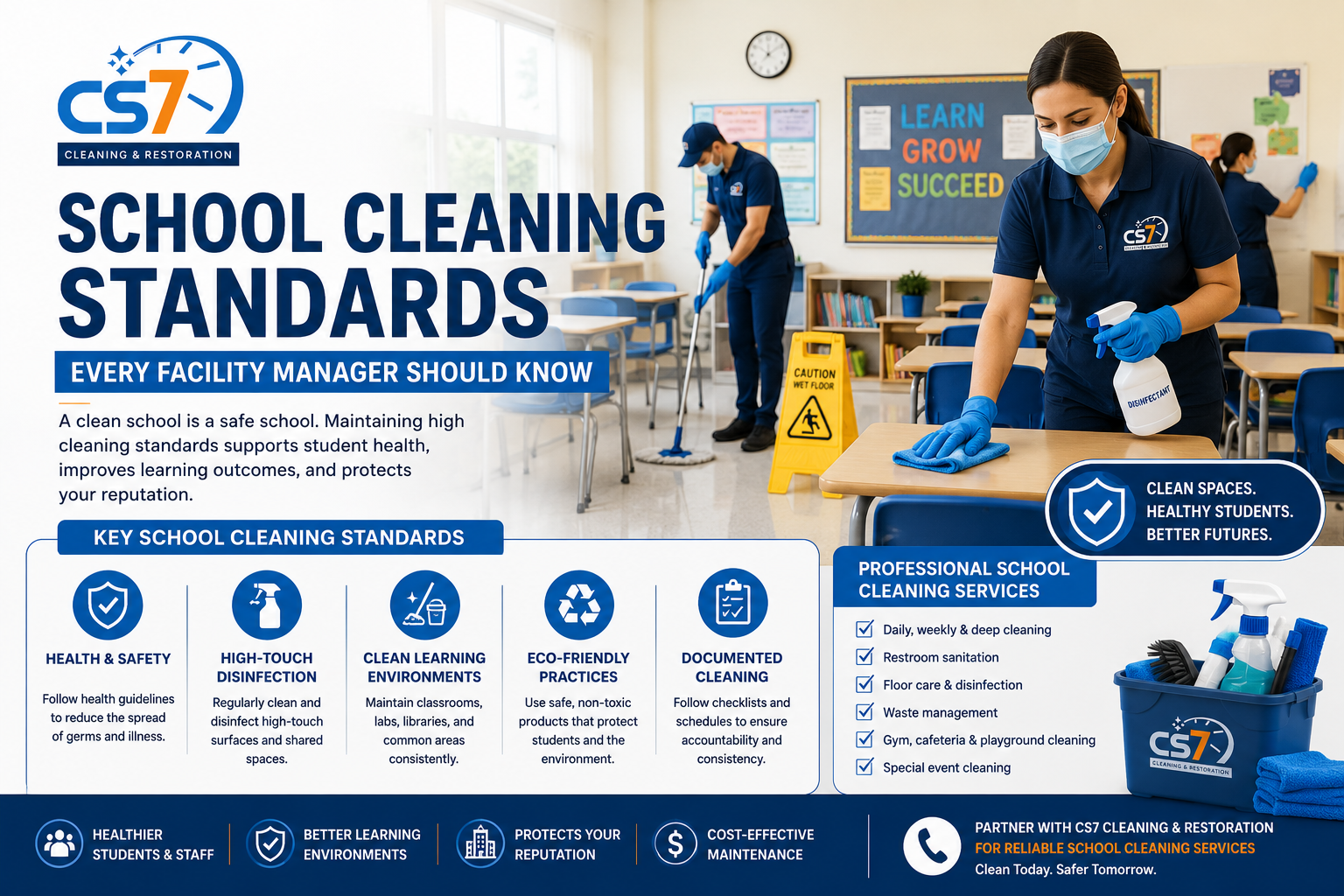
Schools Are Not Office Buildings — And Cleaning Them Like One Is a Problem
A standard commercial cleaning contract applied to a school is not going to cover what a school actually needs. The difference is not a matter of scale — it is a matter of environment. Schools bring together hundreds of people in close quarters, many of them children whose immune systems are still developing, across spaces that are used intensively from morning drop-off through after-school programs. The contamination profile of a school is genuinely different from an office building, and the cleaning standard has to reflect that.
This guide is written for facility managers and school administrators in Manitoba who are responsible for the cleanliness and sanitation of a school building — whether that is a single K–8 facility in a small southern Manitoba community or a multi-building secondary school campus in Winnipeg. The goal is a clear, practical reference for what school cleaning standards should actually look like: what to clean, how often, and what the gaps are in programs that look adequate on paper but miss what matters in practice.
Scope of this guide: K–12 schools including elementary, middle, and secondary facilities. Applies to both public and independent schools, and to facility managers working with in-house custodial teams or external commercial cleaning contractors. Manitoba-specific context is included throughout — particularly for the winter months that define so much of the school year here.
Why Schools Require a Higher Cleaning Standard
The case for rigorous school cleaning is not just about appearances. It is about the specific conditions that make schools one of the highest-risk environments for illness transmission in any community.
👦 The Occupant Problem
- Children touch their faces far more frequently than adults — transferring pathogens from surfaces to mucous membranes continuously
- Hand hygiene compliance in school-age children is lower than in adult work environments, even with reminders
- Shared materials — pencils, scissors, manipulatives, keyboards — create high-frequency surface-to-hand-to-face transmission chains
- Children with developing immune systems are more susceptible to respiratory and gastrointestinal illness than healthy adults
- Sick children are often sent to school before symptoms are recognized by parents, extending transmission windows
🏫 The Environment Problem
- High density — 25 to 30 students in a single classroom for six or more hours creates sustained close-contact exposure
- Poor ventilation in older Manitoba school buildings concentrates airborne pathogens
- Shared washrooms used by large numbers of students with variable hygiene habits
- Common areas — gyms, cafeterias, libraries — cycle through hundreds of students per day across different year groups
- Extended building hours for after-school programs and community use mean facilities never fully reset between occupant groups
The operational consequence of these conditions is straightforward: surfaces in schools recontaminate faster than in any other commercial environment of comparable size. A conference room cleaned at 6 PM may still be clean at 8 AM. A classroom cleaned at 6 PM is not — it has 28 students in it by 8:30 AM and contamination levels begin climbing within the first hour of the school day.
The Master Frequency Framework for School Cleaning
Before breaking down cleaning by space type, facility managers need a clear master schedule. The right framework for a school is more aggressive than most commercial cleaning schedules — and certain tasks that would be weekly in an office environment are daily requirements in a school.
| Frequency | What It Covers | Space Type | Priority |
|---|---|---|---|
| During school day | Washroom checks and restocking, spill response, cafeteria wipe-downs between lunch periods, entry mat management | All High-Traffic Zones | Critical |
| Daily (after hours) | Full classroom cleaning and disinfection, washroom deep clean, cafeteria and gym floors, all high-touch surface disinfection, garbage removal building-wide, corridor vacuuming and mopping | All Occupied Spaces | Critical |
| Weekly | Desk and chair disinfection, window ledge and sill dusting, locker exterior wipe-down, library surface cleaning, stairwell deep clean, gym equipment wipe-down | Classrooms & Common Areas | Standard |
| Monthly | Floor stripping and waxing, high-surface dust removal, gymnasium bleacher cleaning, storage area organization and clean, kitchen equipment deep clean | Facility-Wide | Maintenance |
| Seasonal / Break | Full deep cleaning during winter and spring breaks, carpet extraction, duct cleaning, window washing, gymnasium floor resurfacing, locker interior cleaning | Whole Building | Scheduled |
| Annual / Summer | Complete facility deep clean, exterior pressure washing, full floor restoration, painting preparation cleaning, duct system inspection and cleaning, mold assessment | Whole Campus | Summer Break |
The most commonly missed interval: during-the-day washroom checks. Most school cleaning contracts cover after-hours cleaning only. A washroom serving 300 students between 8:30 AM and 3:30 PM without a midday clean is not meeting a standard appropriate for a children's facility — regardless of how thorough the after-hours program is.
Space-by-Space Cleaning Standards
A school is several distinct environments inside one building. Each one has a different contamination profile, different high-risk surfaces, and different cleaning requirements. Expand each space type below for the full standard.
- All hard floor surfaces vacuumed or swept, then mopped with appropriate disinfectant solution
- Carpeted areas vacuumed thoroughly — including under desk rows and along skirting boards
- Teacher's desk surface, podium, and whiteboard ledge wiped and disinfected
- Light switches, door handles, and door frames disinfected — among the highest-contact surfaces in any classroom
- Garbage and recycling bins emptied and relined
- Sink and faucet handles disinfected in classrooms with handwashing stations
- Shared technology surfaces — keyboards, mouse devices, tablets, smartboard pen holders — wiped with appropriate electronics-safe disinfectant
- Student desks and chair surfaces disinfected — seat, back, and underside of desk surface
- Window ledges, sills, and blinds dusted
- Shelving, book ledges, and display surfaces dusted
- Baseboards wiped along all walls
- Shared classroom materials — manipulatives trays, supply bins, art material containers — wiped down
- Interior classroom window glass cleaned on both accessible sides
- Full desk and chair disinfection including underside of desktops — gum, adhesive, and organic buildup accumulates rapidly
- Carpet extraction for carpeted classrooms — winter and spring break are the appropriate windows
- Full floor stripping and waxing for hard floor classrooms — summer break minimum, winter break if traffic warrants
- Ceiling fan blades and light fixture housing dusted and wiped
- Interior storage and supply cupboard interiors wiped out
- Visual inspection of all fixtures — toilets, urinals, sinks — and spot clean as needed
- Supplies restocked — soap, paper towels, toilet paper — before afternoon session
- Floor checked for moisture, debris, or contamination and addressed immediately
- Odour check — persistent odour during the day is a signal the after-hours program is not adequate
- All toilet bowls, seats, rims, and external surfaces scrubbed and disinfected
- Urinals scrubbed including drain screens — biofilm accumulates quickly without daily attention
- All sinks, faucet handles, and soap dispenser bodies disinfected
- Mirror cleaned streak-free and frame wiped
- All touch-point surfaces — door handles, lock latches, light switches, paper towel dispensers, hand dryer buttons — disinfected
- Floors mopped with appropriate disinfectant solution — including behind fixtures and in stall corners
- Waste bins emptied and relined — sanitary disposal units serviced
- Full supply restock completed so washrooms are ready for the following morning
- Grout lines scrubbed on floor and wall tile — grout is porous and accumulates bacteria without targeted attention
- Partition walls between stalls wiped top-to-bottom on both sides
- Ceiling vent grilles wiped — washroom vents accumulate dust and moisture buildup rapidly
- Behind toilet bases and under sink cabinets mopped and checked for moisture accumulation
- All table surfaces wiped and disinfected between each lunch period — not just at end of day
- Chair seats wiped, especially in primary divisions where younger students have poorer food handling habits
- Floor spot-mopped for spills and food debris between periods — wet floors in a cafeteria are an immediate slip hazard
- Garbage and recycling stations checked and emptied if at capacity before the next period begins
- All tables and benches scrubbed — food residue left overnight attracts pests and is significantly harder to remove than same-day cleaning
- Full floor mop with food-safe disinfectant — including under tables and along wall edges
- Serving counter surfaces, sneeze guards, and tray rails disinfected
- Kitchen adjacent areas — pass-through windows, serving line surfaces — wiped and sanitized
- Garbage, compost, and recycling stations emptied, cleaned, and relined
- Floor drain checked and cleared
- Chair undersides and table bases cleaned — debris accumulates on frame joints and support structures
- Wall splash zones behind serving areas wiped down
- Refrigerator exterior handles and door seals disinfected
- Storage shelving in adjacent prep areas wiped
- Floor deep scrub and waxing treatment — cafeteria floors take more abuse than any other surface in the building
- Refrigerator and freezer interior full clean
- Vent hood and exhaust filter cleaning above any cooking equipment
- Pest inspection perimeter check — food environments are the highest-risk zone for pest activity
- Gym floor dust-mopped after last period — grit and debris left on hardwood gym floors causes surface abrasion
- Change rooms — floors mopped, fixtures disinfected, showers scrubbed (where present), supplies restocked
- Water fountain surfaces disinfected — gyms typically have high fountain usage
- Equipment storage areas swept — debris from outdoor equipment tracked into storage compounds quickly
- Garbage removed from change rooms and gym entry areas
- Gym floor damp-mopped with appropriate hardwood-safe solution — not standard floor cleaner, which can damage finish
- Bleachers or retractable seating wiped — seat surfaces and handrails both
- Shared equipment — pinnies, balls, jump ropes, mats — wiped with appropriate disinfectant where surfaces allow
- Change room benches and locker exterior surfaces disinfected
- Shower grout lines scrubbed where shower facilities are present
- Gymnasium floor professional screening and re-coating — hardwood gym floors require specialist care, not standard floor stripping and waxing
- Full bleacher pull-out and cleaning beneath retractable sections
- Locker interior cleaning during summer break — odour, mold, and pest risk all concentrate in locker interiors
- Ceiling-mounted equipment inspection and cleaning — basketball hoops, divider curtain tracks, scoreboard surfaces
- Main entrance and secondary entrance floors swept and mopped — entry zones are the highest contamination import point in any school
- Entry mats vacuumed or shaken and repositioned correctly — a misaligned mat is a trip hazard
- All corridor floors vacuumed (carpeted) or swept and mopped (hard surface)
- Stairwell floors swept and mopped — handrails disinfected
- Water fountain surfaces and push buttons disinfected
- Locker corridor floors swept — debris from lockers accumulates at the base of locker rows daily
- Main office reception counter and any public-facing surfaces disinfected
- Locker exterior surfaces wiped — particularly door vents and handle areas
- Trophy cases and display cases in corridors dusted
- Bulletin board frames and wall display ledges dusted
- Elevator interior (where present) fully wiped — buttons, walls, floor, handrail
- Window ledges and sills along corridors dusted
- Entry mat deep cleaning or replacement at winter onset — standard mats cannot absorb Manitoba winter contamination volumes
- Corridor carpet extraction during winter and spring breaks
- Floor stripping and wax restoration for hard surface corridors — high-traffic hallways lose wax protection faster than any other area in the building
- Exterior entrance pressure washing at spring break — salt residue and winter grit removal from entry surfaces
- Library floors vacuumed and hard surfaces mopped
- Library computer stations and shared device surfaces wiped with electronics-safe disinfectant
- Administration office floors vacuumed and high-touch surfaces disinfected — door handles, counter surfaces, copier/printer buttons
- Staff room cleaned — countertops, sink, appliance handles, floor, garbage removed
- Nurse or first aid room disinfected to the highest standard in the building — this space sees the most acutely unwell students
- Library shelving dusted — accumulated book dust is a significant allergen source
- Library soft seating and study tables wiped
- Staff room appliances — microwave interior, fridge handles, coffee station — cleaned thoroughly
- Administration filing areas and desktop surfaces dusted
Manitoba Schools in Winter — A Separate Problem
The school year in Manitoba runs almost entirely through the cold season. September through June covers the bulk of the heating period, and everything that Manitoba winters do to a commercial building — salt tracking, moisture infiltration, compressed indoor air quality — happens in a building full of children.
❄️ Winter Is Not a Season — It Is the School Year
For Manitoba facility managers, the school year and the winter cleaning challenge are essentially the same thing. From the first heavy snowfall in October through the mud and slush of April, schools are tracking in contamination at entry points faster than most after-hours programs are designed to handle.
The practical adjustments that need to be built into every Manitoba school cleaning contract from October to April:
- Heavy-duty entry mat upgrade at all exterior doors — standard mats are not rated for Manitoba winter volumes. Commercial-grade deep pile mats that can absorb multiple inches of wet contamination are the appropriate specification.
- Increased entry zone cleaning frequency on snowfall days — the corridor immediately inside an exterior door on a heavy snowfall morning needs attention before lunch, not just at end of day.
- Pre-winter floor treatment — floor stripping and waxing scheduled in September provides the protective layer that determines how well hard surface floors hold up under five months of salt exposure.
- Increased HVAC filter monitoring — winter heating runtime saturates filters faster. A school with a filter change schedule calibrated for spring and fall conditions will be running degraded air filtration by December.
- Carpet extraction in winter break, not just summer — carpeted areas in schools accumulate salt crystals, moisture, and embedded contamination through the fall term. The winter break is the right window to extract before the second half of the school year.
- Outdoor play equipment surfaces — play structures that get foot traffic in shoulder-season mild periods between snow events track significant contamination into school entries. Entry cleaning should account for this.
The Disinfection Question — Cleaning vs. Disinfecting in a School Context
One of the most important distinctions a facility manager needs to be clear on is the difference between cleaning and disinfecting — because most janitorial contracts deliver cleaning, and assume that disinfection is covered as part of it. In a school, it is not.
Cleaning removes visible dirt, organic matter, and debris from a surface. It reduces the number of pathogens present but does not eliminate them. Disinfecting uses a chemical agent to kill pathogens on a surface — but only works effectively on a surface that has already been cleaned. Both steps are always required in a school environment. Neither is a substitute for the other.
The practical implications for school cleaning contracts:
- Product selection matters: not all cleaning products are disinfectants. A contract that specifies "cleaning and disinfecting" but uses a single multi-purpose cleaner for all surfaces may not be achieving actual disinfection on high-touch surfaces.
- Dwell time must be respected: disinfectants require contact time — typically 30 seconds to several minutes depending on the product — to kill pathogens. A surface wiped immediately after product application has been cleaned, not disinfected.
- Surface compatibility: some disinfectants damage specific materials — particularly technology surfaces, gym floors, and food-contact surfaces in cafeterias. A school cleaning program needs product specifications matched to surface types throughout the building.
- Enhanced disinfection after illness events: when a significant illness event occurs — a gastrointestinal outbreak, a confirmed influenza case in a classroom — the standard daily cleaning program is not sufficient. CS7 offers disinfection fogging services that can be deployed for targeted sanitization of affected areas.
After a known illness outbreak in a school: all surfaces in the affected classroom and adjacent washrooms should be cleaned and disinfected with a product rated for the specific pathogen, with appropriate dwell time. High-touch surfaces in common areas should also be included. This is a separate protocol from the routine daily program — and it should be in writing in your cleaning contract before you need it.
What a Proper School Cleaning Contract Covers
Facility managers reviewing or tendering a school cleaning contract should look for specific elements that distinguish a program built for a school environment from a standard commercial janitorial contract with a school listed as the client.
- Space-specific task lists — classrooms, washrooms, cafeteria, gymnasium, corridors, and administration areas all documented separately with their own frequency requirements. A single generic task list applied to a whole school building is not an adequate scope.
- During-the-day service provisions — at minimum, washroom midday checks and cafeteria between-period wipe-downs. If the contract covers only after-hours cleaning, the daytime contamination load in a school building is going unaddressed.
- Documented cleaning logs left on-site after every visit. Logs should cover which spaces were cleaned, what products were used, and who performed the work. This protects the school in the event of a health complaint or inspection.
- Seasonal scope provisions — explicit provisions for winter entry mat management, increased entry zone frequency from October through April, and pre-winter floor treatment scheduling.
- Break deep cleaning schedule — winter and spring break deep cleaning, including carpet extraction, full floor restoration, and duct inspection, should be scheduled in advance and included in the annual contract scope.
- Illness response protocol — written procedure for enhanced cleaning and disinfection when a significant illness event is reported, including what surfaces are covered, what products are used, and what the response timeline is.
- Assigned, consistent staff — rotating crews who do not know the building create inconsistency and leave gaps in coverage. Schools benefit significantly from assigned custodial staff who know the facility and its specific requirements.
Summer Deep Cleaning — The Annual Reset Every School Needs
The summer break is the only period in the school year when a full building reset is possible. Six to eight weeks of vacancy and unrestricted access provides the window for everything that cannot be done during the school year — and most of it genuinely cannot wait another year.
A complete summer deep cleaning program for a Manitoba school building should include:
🧹 Floors & Surfaces
- Full floor stripping and waxing throughout the building — classrooms, corridors, cafeteria, gymnasium surrounds
- Carpet extraction for all carpeted classrooms, libraries, and offices
- Gymnasium hardwood floor assessment and professional resurfacing or re-coating as warranted
- Tile grout line restoration throughout washrooms and cafeteria
- Exterior entry surfaces pressure washed — sidewalks, entry pads, loading areas
💨 Air & Mechanical
- Duct cleaning — summer is the ideal window with the building unoccupied and HVAC systems accessible
- All HVAC filters replaced building-wide at summer start
- Washroom exhaust fans and vent grilles cleaned
- Classroom ceiling fans and portable air units cleaned where present
🔬 High-Risk Zones
- Nurse's office and first aid areas fully disinfected and restocked
- Locker interiors cleaned — often skipped during the year and accumulate significant contamination by June
- Kitchen and cafeteria deep clean including refrigeration units, exhaust systems, and drain lines
- Mold assessment in washrooms, change rooms, and any areas with known moisture issues
🪟 Structure & Exterior
- Interior window washing — full building
- Exterior window cleaning on accessible ground-level surfaces
- Exterior entry and perimeter pressure washing
- Dumpster pad cleaning and odour treatment
- Portable classroom units (where applicable) deep cleaned on the same schedule as main building
How CS7 Supports School Facility Teams Across Manitoba
CS7 Cleaning & Restoration provides commercial cleaning services for schools, educational facilities, and institutional buildings across Winnipeg and southern Manitoba. The scope of work ranges from ongoing daily and weekly janitorial programs through to full summer deep cleaning, floor restoration, carpet extraction, duct cleaning, and emergency response for water or contamination events.
Schools that work with CS7 receive documented cleaning logs after every service, assigned crew members who build familiarity with the facility, and seasonal scope adjustments built into the program — not added as extras when the situation becomes urgent.
If your school or division is currently reviewing its cleaning contract, or if the program in place has not been formally audited against current standards, we are available for a no-obligation site assessment and scope review across any facility in our service area.
School Cleaning Standards — Common Questions
School & Educational Facility Cleaning — Where We Serve
CS7 provides structured, protocol-based cleaning for K–12 schools, colleges, and educational facilities across Winnipeg and southern Manitoba — with documented service records, assigned crews, and seasonal programs built for Manitoba's climate.
Related Guides & Resources
School Cleaning Services Manitoba
Ready to Build a Proper School Cleaning Program?
CS7 Cleaning & Restoration provides structured cleaning programs for K–12 schools and educational facilities across Winnipeg and Manitoba — with documented logs, assigned crews, seasonal adjustments, and full deep cleaning programs for every school break.
📍 Winnipeg · Brandon · Winkler · Morden · Steinbach · Altona · Carman · Portage la Prairie · Morris
✉ info@cleaningservice7.com