Property Managers Are Often Managing the Wrong Thing
Most property managers in Manitoba have some cleaning arrangement in place. The issue is rarely the absence of cleaning — it is the absence of a structured, property-specific cleaning program that maps to the actual risk profile of the building.
A generic janitorial contract applied across a mixed-use office building, an industrial warehouse, and a retail strip centre is going to leave gaps. And those gaps accumulate. What looks presentable during a tenant walkthrough can mask real maintenance debt — floor surfaces degrading under traffic, restrooms that have not been deep-cleaned in months, entry areas tracking contamination through the building every winter.
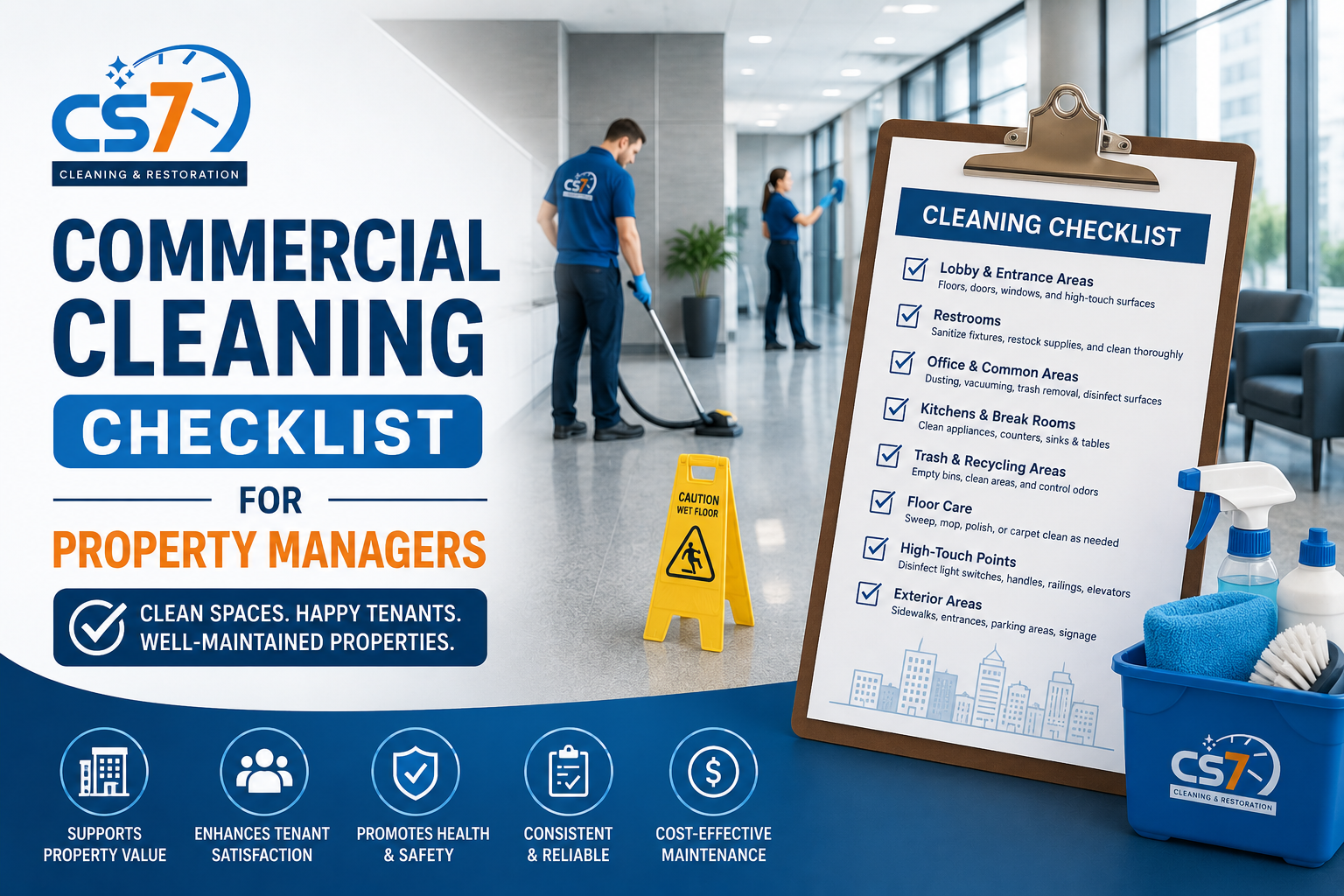
This checklist is built for property managers in Winnipeg and across southern Manitoba who are responsible for commercial property cleaning across one or more sites and need a practical structure — not a generic template — to audit, build, or improve their current program.
How to use this checklist: work through each section against your current cleaning scope. Where your existing program does not cover an area, that is a gap worth addressing with your contractor — or a signal that the contract needs renegotiating. This guide covers office buildings, retail properties, multi-tenant commercial spaces, and light industrial or warehouse facilities.
Part 1 — The Master Frequency Framework
Before diving into property-type specifics, every property manager needs a clear master schedule that maps cleaning tasks to the right frequency. This is the baseline that everything else builds on.
| Frequency | Task Category | What It Covers | Priority |
|---|---|---|---|
| Daily | High-touch surface disinfection, restrooms, lobby floors, garbage removal | Any occupied commercial space with daily foot traffic | Critical |
| 2–3× per week | Full vacuuming, hard floor mopping, glass and partition cleaning, breakroom full clean | Office suites, reception areas, meeting rooms | Standard |
| Weekly | Baseboards, window sills, storage areas, behind furniture, stairwells, elevator interiors | Building-wide — all property types | Standard |
| Monthly | Floor stripping and waxing, high-surface dusting, carpet spot treatment, vent grille cleaning | Facilities with vinyl, tile, or waxed concrete floors | Maintenance |
| Quarterly | Full deep cleaning, carpet extraction, pressure washing exterior entries, grout restoration | All commercial properties | Seasonal |
| Annual / As-needed | Duct cleaning, window washing (exterior), post-renovation cleanup, fire or water restoration response | Triggered by events, inspections, or lease turns | Scheduled |
This frequency framework is the skeleton. The property-type checklists below add the muscle — what specifically needs to happen at each interval, across each type of commercial building.
Part 2 — Property-Type Checklists
Click on the property type that matches your portfolio to expand the full checklist. Most property managers oversee more than one type — work through each that applies.
- Lobby and reception floors vacuumed and mopped — hard floors and carpet entry mats both
- Elevator interior floors, walls, and button panels wiped and disinfected
- All restrooms cleaned, disinfected, and restocked — fixtures, floors, dispensers
- Garbage and recycling bins emptied in all common areas and tenant lobbies
- High-touch surfaces disinfected — door handles, intercom buttons, mailroom surfaces
- Stairwells vacuumed and mopped, including landings and handrails wiped
- Interior glass — lobby doors, partition glass, directory boards — cleaned streak-free
- Baseboards, window ledges, and sills dusted throughout common areas
- Parking level stairwells and elevator lobbies swept and mopped
- Building directory and signage cleaned
- Floor stripping and waxing for vinyl and tile lobby surfaces
- Exterior entry mat rotation or deep cleaning
- High-surface dusting — light fixtures, HVAC vents, sprinkler heads
- Parking structure pressure washing at seasonal transitions
- Annual duct cleaning assessment for common area HVAC
- Common area floors — tile, polished concrete, or sealed surfaces — swept and mopped after close
- Food court or seating areas (if present) fully sanitized — tables, chairs, floors, waste stations
- Public washrooms cleaned and restocked — minimum twice daily in busy properties
- Entry vestibules and exterior mat areas swept, mat positioned correctly
- Garbage and recycling compactor areas cleaned — odor control is a tenant relations issue
- Storefront glass on common-area-facing doors cleaned from the landlord side
- Corridor baseboards and kickplates wiped — scuff marks from carts and foot traffic accumulate fast
- Loading dock area swept and pressure-washed as needed
- Exterior entrance areas cleared of debris, cigarette butts, and organic matter
- Floor maintenance and waxing for high-traffic common area flooring
- Exterior pressure washing — sidewalks, curbs, dumpster pads
- Seasonal entry mat replacement at winter onset and spring
- Interior signage and wayfinding fixtures cleaned and dusted
- Warehouse floor swept and mopped or scrubbed — depending on surface and contamination type
- Staff washrooms and change rooms cleaned and restocked at each shift end
- Break room or lunchroom cleaned — surfaces, appliances, floor, garbage removed
- Waste and recycling stations cleared and area cleaned around disposal points
- Dock doors and loading bay floors swept of debris and product residue
- Office areas within the facility vacuumed, dusted, and hard floors mopped
- Safety signage and floor markings checked for visibility — cleaning should not obscure them
- Exterior dock and yard areas swept — debris around loading zones is both a safety and optics issue
- Interior windows and skylights cleaned from accessible points
- Industrial deep cleaning of facility floor — including under racking and equipment
- High-bay dust removal from beams, lighting fixtures, and upper rack levels
- Exterior pressure washing of facility perimeter and dock surfaces
- Grease trap and drain cleaning in production or processing areas
- Duct and ventilation cleaning on a rotating annual schedule
- Move-out cleaning for vacating tenants — full suite cleaning before new tenant inspection
- Post-construction cleaning after any TI work — dust, debris, adhesive residue, window film removal
- Common area deep clean following major renovation or build-out activity in adjacent suites
- Air quality management — disinfection fogging after construction activity
- Stairwells and shared lobbies serving both residential and commercial tenants cleaned daily
- Garbage and recycling infrastructure — especially in mixed-use — audited weekly for overflow and odor
- Exterior common areas — courtyards, bike storage, entry paths — cleared and swept
- Parking structure maintained per office building schedule above
Note for multi-property managers: a checklist is only useful if it is operationalized — assigned, scheduled, and verified. A laminated checklist on a broom closet door that no one inspects is not a cleaning program. It is a paper trail with no oversight.
Part 3 — The Manitoba Winter Factor
Property managers in Ontario or BC deal with wet weather. Property managers in Manitoba deal with a different category of problem — one that runs from October through April and involves salt, sand, road slush, and temperatures that freeze standing moisture at entry points.
The standard commercial cleaning schedule that works from May to September is not adequate from November to March. A building that runs on the same cleaning frequency year-round is going to experience accelerated floor damage, elevated slip risk at entries, and increased contamination spread through the facility.
❄️ Winter Entry Management
- Switch to heavy-duty entry mats at all exterior doors in October — standard mats do not absorb enough
- Mat laundering or replacement on a weekly cycle during peak winter months
- Entry vestibule floors mopped twice daily on snowfall days — not just at closing
- Salt and grit residue tracked into lobbies swept before it spreads to carpeted areas
- Ice melt application at all exterior entries — documented as part of the cleaning contract scope
🧹 Floor Protection
- Schedule floor stripping and waxing in October — before winter salt exposure begins
- Vinyl and tile floors treated with adequate wax coating hold up to salt damage significantly better than bare tile
- Hardwood and laminate in common areas need more frequent mopping and drier mop technique in winter
- Carpet extraction scheduled for March or April to remove embedded salt crystals and winter moisture
🌡️ Restroom & Washroom Adjustment
- Restroom cleaning frequency should increase in winter — more people spending more time inside means higher throughput
- Increased moisture from winter gear and outerwear creates humidity in washrooms — ventilation checks matter
- Floor drains in washrooms inspected more often — blockages cause contamination spread quickly
🏗️ Exterior & Perimeter
- Exterior pressure washing paused in freezing temperatures — reschedule to spring
- Snow removal from building entrances coordinated with interior mat cleaning
- Dumpster pad areas kept clear of ice buildup — a safety and odor issue simultaneously
- Exterior window cleaning moved to weather-permitting windows rather than fixed schedule
Part 4 — What Your Cleaning Contract Should Actually Include
One of the most consistent problems in commercial property cleaning is the gap between what a cleaning contract says and what actually happens on site. Property managers who inherit a building often discover that the cleaning scope agreed to two years ago does not match current traffic levels, tenant mix, or building use.
A properly structured commercial cleaning contract for property management should include:
- Site-specific scope documents — not a generic "commercial cleaning" description. Each building should have its own task list broken down by area and frequency.
- Documented cleaning logs left on-site after every visit. This is your paper trail for tenant complaints, insurance purposes, and lease compliance.
- Named crew assignment — rotating staff who do not know the building create inconsistent results. Your contract should specify consistent team assignment for each property.
- Supervisor inspection visits on a set schedule — not just when a complaint is raised. Reactive-only oversight is not oversight.
- Seasonal scope adjustments built in — including explicit winter entry mat, floor care, and frequency provisions from October to April.
- Emergency response provisions — what happens if there is a water damage incident, a fire or smoke event, or a contamination issue in a tenant space? Your contractor should have a documented emergency response protocol.
- Clear escalation process — who do you call, what is the response SLA, and what happens if the issue is not resolved in that window?
🏢 Multi-Site Property Management — One Point of Contact
Managing cleaning across five or fifteen buildings with five or fifteen different contractor relationships is an inefficiency most property managers tolerate unnecessarily. A single cleaning contractor operating across your full portfolio means standardized checklists, consistent reporting, centralized billing, and one call when something goes wrong. CS7 manages commercial cleaning programs across multiple properties for property management groups throughout Winnipeg and southern Manitoba — with standardized documentation and a single point of contact for the entire portfolio.
Part 5 — Compliance, Liability, and the Cleaning Audit
A cleaning program is not just a maintenance expense. For property managers, it is part of your liability management. A slip-and-fall at an entry that was not properly cleared of ice and moisture. Mold discovered in a tenant space because a slow water leak was missed during routine cleaning visits. A tenant complaint that cleaning was not performed per the lease addendum.
These are not hypothetical scenarios. They are the claims that documented cleaning programs either prevent or defend against — and undocumented programs almost always make worse.
A cleaning audit — an independent review of your current cleaning scope against your building's actual requirements — is the fastest way to identify where your program has drifted. Key things a proper cleaning audit covers:
- Scope vs. reality check: does the contractor's task list match what is actually being performed? Walk a site with the checklist and see.
- Log review: are cleaning logs being completed consistently? Gaps in documentation are gaps in accountability.
- Surface condition assessment: floor surfaces, restroom fixtures, carpet condition, and entry areas all tell you how the program has been performing over the past six to twelve months.
- Frequency adequacy: is the cleaning frequency appropriate for current tenant traffic? A building at 90% occupancy with the same cleaning schedule it had at 50% is underserviced.
- Seasonal adjustment verification: was the winter protocol actually implemented? Were mats upgraded, floor treatments applied, and frequencies adjusted?
Red flags in your current cleaning program: no cleaning logs left on-site · different crew members on every visit · no supervisor inspection visits in the past quarter · the cleaning scope has not been reviewed since the contract was signed · you only hear about cleaning issues when a tenant complains · the contract does not include seasonal provisions for Manitoba winters.
How CS7 Supports Property Managers Across Manitoba
CS7 Cleaning & Restoration has worked with property managers across Winnipeg and southern Manitoba for over 20 years. The work spans routine commercial cleaning, deep cleaning and seasonal programs, floor care and restoration, post-construction and post-renovation cleanup, and emergency response for water and fire damage.
If you manage one building or fifteen, and your current cleaning program is not properly documented, structured, or adapted for Manitoba's climate — we offer a no-obligation site assessment that will identify exactly where the gaps are and what a proper program would cost to run.
Commercial Cleaning for Property Managers — Common Questions
Property Management Cleaning — Where We Serve
CS7 provides structured commercial cleaning programs for property managers across Winnipeg and southern Manitoba — office buildings, retail centres, industrial facilities, and mixed-use properties.
Related Guides & Resources
Commercial Cleaning for Property Managers — Manitoba
Ready to Build a Proper Commercial Cleaning Program?
CS7 Cleaning & Restoration provides structured commercial cleaning programs for property managers across Winnipeg and Manitoba — office buildings, retail centres, industrial facilities, and multi-site portfolios that need consistent, documented, and properly managed cleaning.
📍 Winnipeg · Brandon · Winkler · Morden · Steinbach · Altona · Carman · Portage la Prairie · Morris
✉ info@cleaningservice7.com