
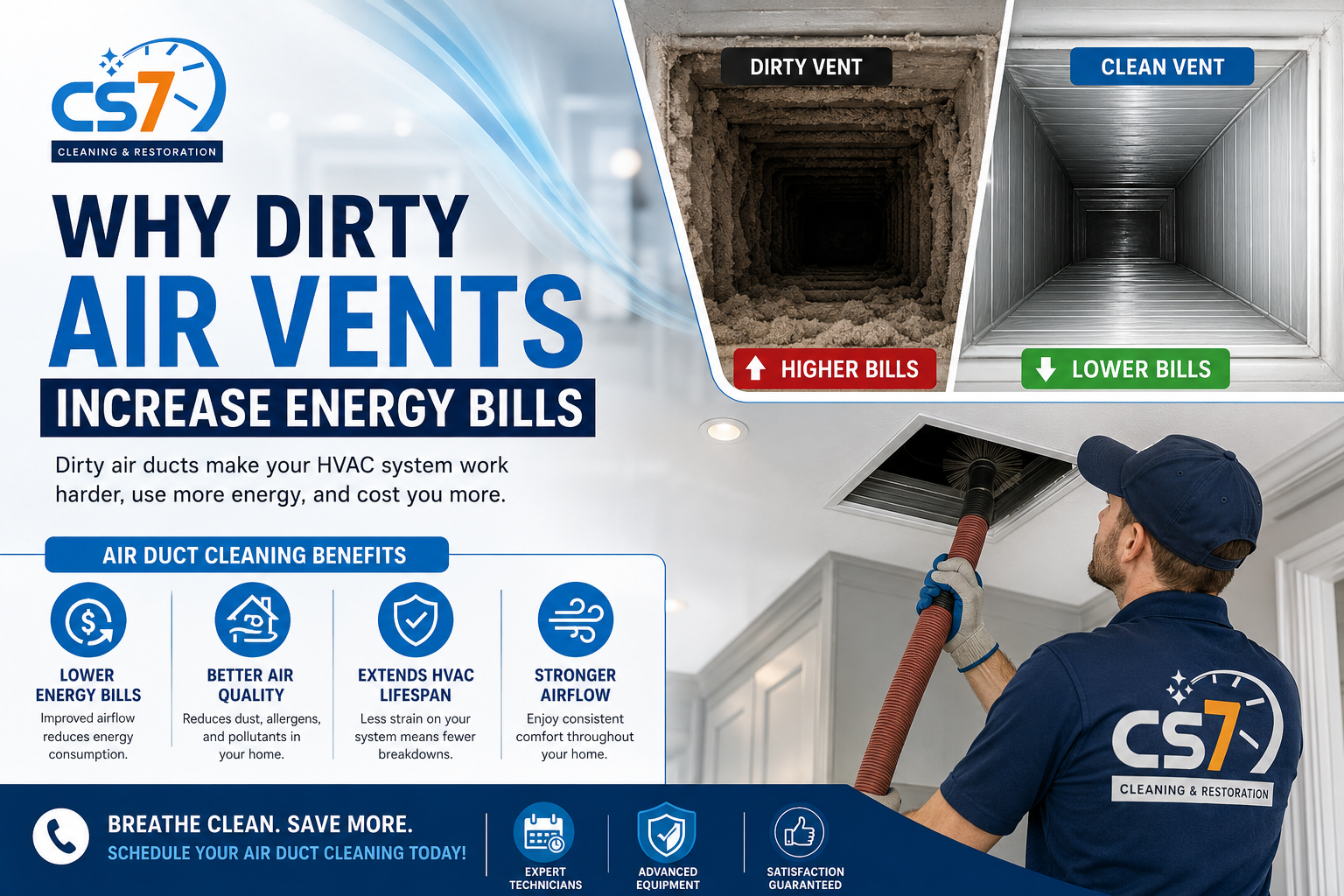
Your HVAC Is Working Harder Than It Should — Here Is Why
Most Manitoba homeowners and facility managers notice their energy bills creeping up and start looking at the obvious suspects — heating settings, insulation, appliance efficiency. The one thing most people do not check is sitting inside the walls, ceiling, and floor of the building: the ductwork.
Dirty air vents and clogged ducts are one of the most consistent and overlooked causes of elevated heating and cooling costs in both residential and commercial buildings. The relationship is direct and mechanical — it is not a stretch or a sales pitch. When airflow through a duct system is restricted by accumulated dust, debris, and buildup, the HVAC system works harder to move the same volume of air. That extra work shows up on your energy bill every single month.
This guide explains exactly how that happens, what the signs look like, and what professional duct cleaning actually does to fix it — with specific context for Manitoba's climate, where HVAC systems run harder and longer than in most other provinces.
Who this applies to: homeowners in Winnipeg and southern Manitoba, commercial property managers, facility teams in office buildings, and anyone who has noticed their heating or cooling costs rising without a clear reason. Duct cleaning benefits both residential and commercial systems — the scale differs, but the mechanics are the same.
The Mechanics: How Dirty Ducts Actually Cost You Money
To understand why dirty ducts raise energy bills, you need to understand what a duct system is actually doing. Its job is to distribute conditioned air — heated in winter, cooled in summer — evenly through every room in a building. The furnace or air handler pushes air through the system, and the ducts are the delivery network.
When ducts accumulate debris — dust, pet dander, insulation fibres, construction particulate, mold spores, or any combination of the above — the interior diameter of the duct effectively narrows. The airflow path gets tighter. The HVAC system, which is calibrated to move a certain volume of air at a certain pressure, now has to work against that resistance.
📉 What Restricted Airflow Does to Your System
- Furnace or air handler motor runs longer per cycle to compensate for reduced throughput
- System struggles to reach thermostat setpoint — cycling more frequently
- Uneven temperature distribution across rooms — some areas overconditioned, others under
- Filter becomes saturated faster because debris is recirculating rather than being captured
- Heat exchanger in gas furnaces runs hotter than designed — accelerating wear
💸 How That Translates to Higher Bills
- Longer run times mean more gas or electricity consumed per heating or cooling cycle
- Frequent short-cycling (turning on and off) is inherently less efficient than sustained operation
- An HVAC system running at reduced efficiency can consume 20–30% more energy than a clean, well-maintained system
- Overworked components fail earlier — repair and replacement costs compound the energy waste
- Rooms that never reach setpoint stay uncomfortable — leading people to raise thermostat further
Manitoba Makes This Worse Than Most Places
The energy cost of dirty ducts is a problem everywhere — but it is a more significant problem in Manitoba than in most Canadian provinces. The reason is runtime.
Winnipeg regularly records some of the coldest temperatures of any major city in the country. A heating system in Manitoba does not run for a few months — it runs hard from October through April, and is still needed in May more often than most homeowners would like. That is six to seven months of sustained operation every year.
More runtime means more air moving through the duct system. More air movement means faster accumulation of debris inside the ducts. Faster accumulation means the efficiency penalty from dirty ducts compounds more quickly in Manitoba than it would in a milder climate. A duct system that might be fine for four years in southern Ontario can reach problematic restriction levels in three years in Winnipeg — or faster in a high-traffic commercial building.
Manitoba winters also bring specific contaminants that accelerate duct buildup:
- Salt and road grit drawn in through fresh-air intakes — Manitoba's aggressive road salting from November onward sends particulate through building ventilation systems
- Dry winter air increases static dust suspension — particles stay airborne longer and travel deeper into duct systems before settling
- High furnace runtime means filters saturate faster — a filter at capacity stops capturing particulate and lets it pass through into the ductwork
- Moisture from snow and ice at air intake points — can introduce humidity into duct interiors, creating conditions where dust accumulation transitions into mold growth
❄️ The Manitoba Winter HVAC Reality
A furnace in Winnipeg runs approximately twice as many hours per year as one in Vancouver. That means a Manitoba duct system accumulates roughly twice the debris in the same calendar period. If your last duct cleaning was more than three years ago — and you have not changed anything about your filter maintenance, pet situation, or renovation activity — your system is very likely running at reduced efficiency right now. That inefficiency has a monthly dollar cost that has been accumulating since the last cleaning.
The Signs Your Ducts Are Affecting Your Energy Bills
Dirty ducts do not announce themselves directly. The signals show up as symptoms — in your energy bills, in your comfort levels, and in how your HVAC system behaves. Here is what to look for:
📊 Energy & System Signs
- Heating or cooling bills noticeably higher than the same period last year — without a rate increase explanation
- Furnace or air conditioner running longer cycles than it used to
- System short-cycling — turning on and off more frequently
- Thermostat setpoint taking significantly longer to reach than it used to
- Filters becoming visibly dirty within two to three weeks of replacement
🏠 Comfort & Air Quality Signs
- Rooms that are consistently warmer or colder than the rest of the building
- Visible dust accumulation on vent covers and registers — even shortly after cleaning
- Musty or stale odour when the heating or cooling system first turns on each season
- Increased allergy or respiratory symptoms among occupants — particularly in winter when windows are closed
- Dust settling quickly on surfaces after cleaning — a sign particulate is being redistributed through the air
The most overlooked signal: filters clogging faster than the manufacturer's recommended replacement interval. If you are replacing your furnace filter every two to three weeks instead of every one to three months, your ducts are likely contributing — debris and particulate are bypassing the filter and recirculating, then coming back around to clog the filter again on the next pass.
What Professional Duct Cleaning Actually Does
There is a gap between what most people assume duct cleaning involves and what a properly performed cleaning actually covers. Vacuuming the vent covers is not duct cleaning. Replacing the filter is not duct cleaning. A full professional duct cleaning service is a systematic process that addresses the entire air distribution system.
System Inspection & Assessment
Before cleaning begins, the technician inspects the duct system — identifying blockage points, checking for mold or moisture evidence, assessing the condition of duct connections and insulation, and establishing a baseline for what the cleaning needs to address. Camera inspection is used in commercial systems and where access is limited.
Negative Pressure Setup
A high-powered vacuum unit is connected to the main trunk line of the duct system, creating negative pressure throughout the network. This is the core of professional duct cleaning — without negative pressure, loosened debris has nowhere controlled to go and simply redistributes through the system.
Mechanical Agitation of Branch Lines
Rotating brushes and compressed air tools are fed through each branch duct — every supply and return line throughout the building. This dislodges debris that has bonded to duct surfaces over years of accumulation. The negative pressure created in step two draws all dislodged material toward the collection point.
Register & Vent Cover Cleaning
All supply registers and return air grilles are removed, cleaned, and reinstalled. These are the visible endpoints of the duct system and among the highest-accumulation points — particularly in floor registers where debris falls in from foot traffic.
Air Handler & Furnace Component Cleaning
The air handler cabinet, blower wheel, evaporator coil (where accessible), and furnace heat exchanger area are cleaned as part of a complete service. These components accumulate debris that directly affects system efficiency and can be a source of odour and air quality issues independent of the ductwork itself.
Optional Sanitization
Where mold, bacteria, or odour issues are identified, sanitization fogging can be applied through the duct system after mechanical cleaning. This is particularly relevant for buildings that have experienced water infiltration, long periods of vacancy, or air quality complaints from occupants.
Duct Cleaning for Commercial Properties — A Different Scale
The energy cost argument for duct cleaning applies equally — and often more forcefully — to commercial facilities. An office building, retail centre, or industrial facility running dirty ductwork is paying an efficiency penalty across a much larger system, with much higher baseline energy consumption.
Commercial duct cleaning considerations that differ from residential:
- Access and scheduling: commercial duct cleaning typically needs to happen outside business hours. CS7 schedules commercial work around operational needs.
- System complexity: commercial HVAC systems often include rooftop units, VAV boxes, and complex zone configurations that require technicians with commercial system experience — not just residential duct cleaning tools scaled up.
- Regulatory and lease considerations: some commercial leases and building codes include provisions about HVAC maintenance. Documented cleaning records support compliance and protect property managers in disputes.
- Frequency: commercial facilities with higher occupancy, food service, manufacturing activity, or construction nearby typically need duct cleaning more frequently than standard residential intervals — often annually or bi-annually rather than every three to five years.
- Post-renovation cleaning: any construction or renovation activity within a commercial building introduces significant drywall dust and particulate into the HVAC system. Post-construction duct cleaning is an essential step before reoccupying renovated spaces.
Commercial property managers: if your building has undergone any tenant improvement work, renovation, or construction activity in the past twelve months and the duct system has not been cleaned since — the system is almost certainly carrying construction particulate. That debris is being redistributed to every tenant on the affected HVAC zones every time the system runs.
The Full Picture: Benefits Beyond Energy Savings
The energy argument is the most quantifiable reason to clean ducts — but it is not the only one. A properly cleaned duct system delivers a cluster of benefits that compound over time.
💨 Air Quality
- Dust, allergens, mold spores, and pet dander removed from the distribution system — not just the filter
- Occupants with allergies, asthma, or respiratory conditions typically notice improvement within the first few weeks after cleaning
- Odours originating in ductwork — pet, mold, construction — eliminated at the source rather than masked
- Particularly significant in winter when windows stay closed and air recirculation is continuous
⚙️ System Longevity
- Blower motor and heat exchanger operating within designed parameters rather than under chronic overload
- Reduced risk of premature component failure — furnace motors, capacitors, and contactors are all affected by extended runtime
- Evaporator coil kept clean — a dirty coil reduces cooling efficiency significantly and can cause ice formation and system shutdown
- Lower maintenance call frequency — many HVAC service calls are triggered by issues that clean ducts would have prevented
🏠 Comfort
- Even temperature distribution restored across all zones — rooms that were consistently cold or warm in the past often improve after cleaning
- System reaches thermostat setpoint faster — shorter run times to achieve the same comfort level
- Less dust settling on surfaces throughout the building — reduced cleaning frequency for furniture, counters, and floors
🛡️ Risk Reduction
- Mold growth in ductwork identified and addressed before it distributes spores building-wide
- Evidence of pest activity in ducts caught during inspection — a known issue in Manitoba's older housing stock
- Documented cleaning records support insurance claims, lease compliance, and liability management for commercial properties
How CS7 Handles Duct Cleaning Across Manitoba
CS7 Cleaning & Restoration provides duct cleaning services for residential and commercial properties across Winnipeg and southern Manitoba. The work covers the full system — not just the registers — with commercial scheduling built around operational hours and residential work available with documented service records left on-site after every job.
If your building has not had a duct cleaning in the past three years — or if you have noticed any of the energy or comfort signs described in this guide — a system inspection is the right starting point. In many cases, the energy savings from a properly cleaned and restored HVAC system offset a meaningful portion of the cleaning cost within the first heating season.
CS7 also offers duct cleaning in Morden and surrounding communities, in addition to Winnipeg-area service. Contact us to discuss scheduling for your property.
Duct Cleaning & Energy Bills — Common Questions
Air Duct Cleaning — Where We Serve
CS7 provides residential and commercial duct cleaning across Winnipeg and southern Manitoba — with documented service records, full system coverage, and scheduling built around your property's needs.
Related Guides & Resources
Duct Cleaning Manitoba
Ready to Stop Paying for Dirty Ducts?
CS7 Cleaning & Restoration provides professional duct cleaning for homes and commercial properties across Winnipeg and Manitoba — full system coverage, documented service records, and scheduling built around your property.
📍 Winnipeg · Brandon · Winkler · Morden · Steinbach · Altona · Carman · Portage la Prairie · Morris
✉ info@cleaningservice7.com